Mental Toughness for Young Athletes: Mastering the Inner Game
By Shane Lypka bio
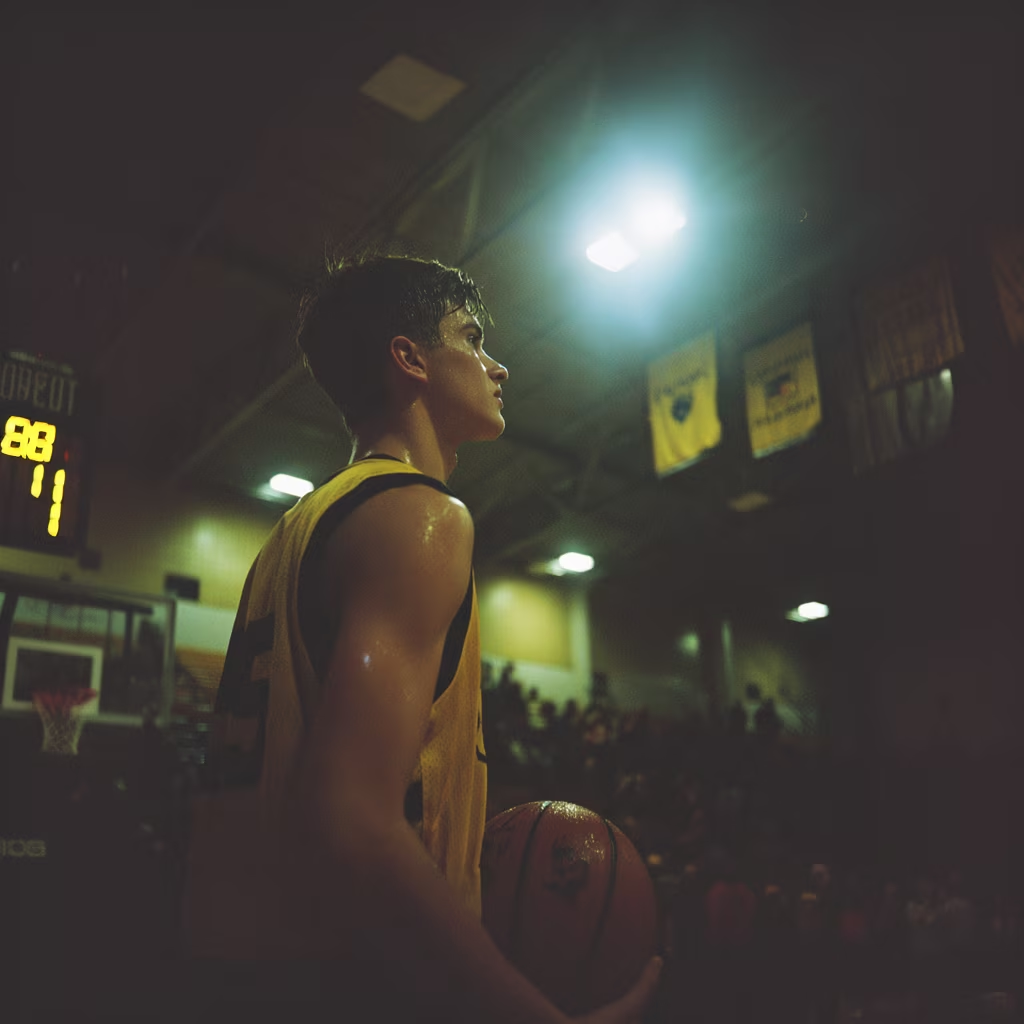
All things being equal, mentally tough young athletes perform better than their peers. Being mentally tough means that a person can manage their mind and body's response to intense situations avoiding high anxiety physiological queues. Below we teach athletes how to diagnose their mental toughness and more importantly, how to improve it with practical exercises so that they're more resilient in big games.
Before diving into the clinical psychology of sports performance, take 60 seconds to establish your son's baseline. Use our free Teen Resilience Pulse-Check to see exactly how he currently handles friction and failure.
Athletic achievement is the result of a hardened mind. We currently inhabit an ecosystem that rewards immediate dopamine and provides a frictionless exit from every difficult task. A.I. does it, parents do it, iPhones do it, games do it, teachers do it, gym teachers do it, grandparents do it - we all seem to be letting kids "off the hook" a lot more than we used to. To some degree, it is excusable; in the good old days, there were some seriously questionable and sometimes abusive coaching, teaching, and parenting techniques.
But we can't lose sight of the value of teaching kids about the work effort and toughness required to fight through failure. Sure, we need to remain deferential to pesky laws and modern civil propriety, but kids still need to build a little resilience in order to grow into reasonable adults. Sports are one of the venues where a young person absolutely must confront the gap between desire and execution. You can't wish to be a great player; you have to work to become a great player. Daddy can't sponsor you into scoring 44 points on the AAU squad; to be the best, you're gonna have to run suicides until your legs burn and you're gonna need to be mentally tough to do it.
"Great works are performed not by strength but by perseverance."
The Science of Hardiness: Control, Commitment, Challenge, and Confidence
Clinical sports psychology defines mental hardiness through the Clough and Strycharczyk model. This framework moves the conversation from vague "grit" to measurable Psychological Skills Training (PST). It is the anatomical map of how a competitor survives the weight of the game.
- Control: The internal locus of control. The absolute belief that the athlete, not the referee or the weather, owns the outcome.
- Commitment: The persistence required to handle the daily labor of a 5:00 AM practice in a cold gym.
- Challenge: The clinical ability to view a superior opponent as an opportunity for growth rather than a threat to the ego.
- Confidence: A sturdy belief in personal abilities that remains unyielding during a loss.
Suzanne Kobasa's foundational research proved that hardiness is a personality structure that resists stress-induced breakdown. In the athletic ecosystem, this hardiness acts as a proactive defense. It turns the stress response from a paralyzing threat into a manageable challenge. Developing these traits is the first step to build resilience in teens beyond the court.
Developing a "Next Play" Mindset: The Social Media Drain
The memory spiral kills more athletic careers than torn ligaments. An athlete misses a shot and begins an autopsy of the mistake while the game is still moving. This error processing failure creates a stuttering performance where the player is mentally stuck in a memory of failure.
Recent clinical data identifies "directed attention fatigue" as a primary obstacle for modern teens. A study on adolescent athletes indicates that high levels of social media scrolling correlate with an "attentional blink." This is a physiological delay in the brain's ability to process new information after a stimulus. If a teen is on a video feed before a game, their brain is literally too tired to concentrate.
The "Flush It" technique is a five-second mental reset designed to terminate the spiral. The athlete visualizes a physical toilet handle and pulls it, flushing the mistake into the sewers of the past. This resets the internal clock and restores concentration. When you teach them that a mistake is a data point, not a verdict, you build resilience in teens.
Physiology Presents Opportunities to Rise or Fall
Calming the Adrenaline Spike Under Pressure
When the stakes rise, the autonomic nervous system takes over. The body floods with adrenaline. The heart rate climbs, and fine motor skills evaporate. This is the fight or flight response. It is the enemy of optimal alertness.
Arousal regulation is the clinical ability to keep the body in the zone of peak performance. The vagus nerve is the key to this regulation. It acts as the physical brake for the nervous system. Higher vagal "tone" or control is associated with better emotional regulation, focus, and cognitive performance under stress, all of which athletes rely on in competition.
Vagus nerve stimulation can be achieved through deliberate physiological overrides. The 4-7-8 breathing drill—inhaling for four, holding for seven, and exhaling for eight—tells the brain that the physical threat is non-existent. It lowers the heart rate and clears the mental fog. This is how you win the inner game before the whistle blows.
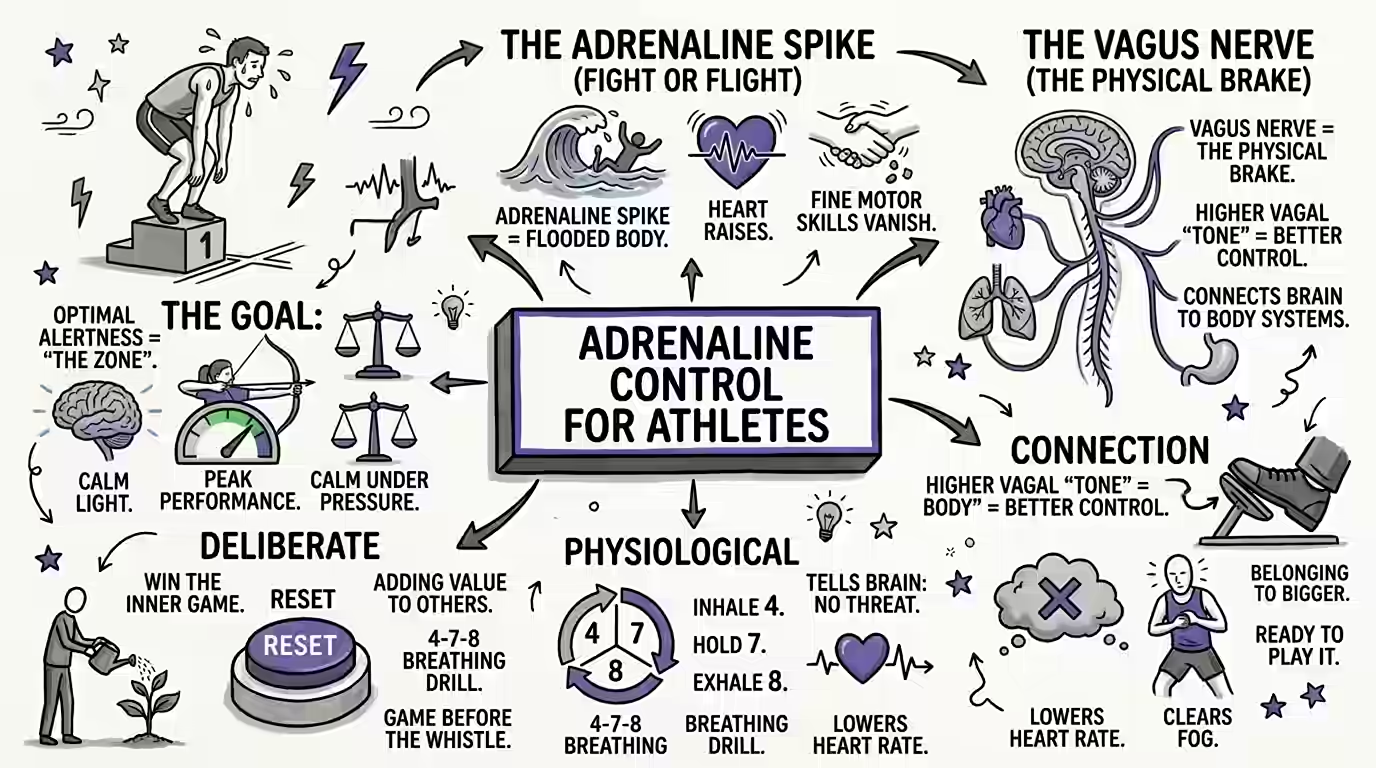
Harnessing the Adrenaline Spike
An athlete who does not understand this physiology is a victim of it. In high-leverage situations, the HPA axis often over-functions, flooding the system with too much cortisol. This leads to the "lock-up"—the performance anxiety that turns muscle into lead. To harness this for optimal performance, the athlete must master his mindset; he must learn to work with the spike.
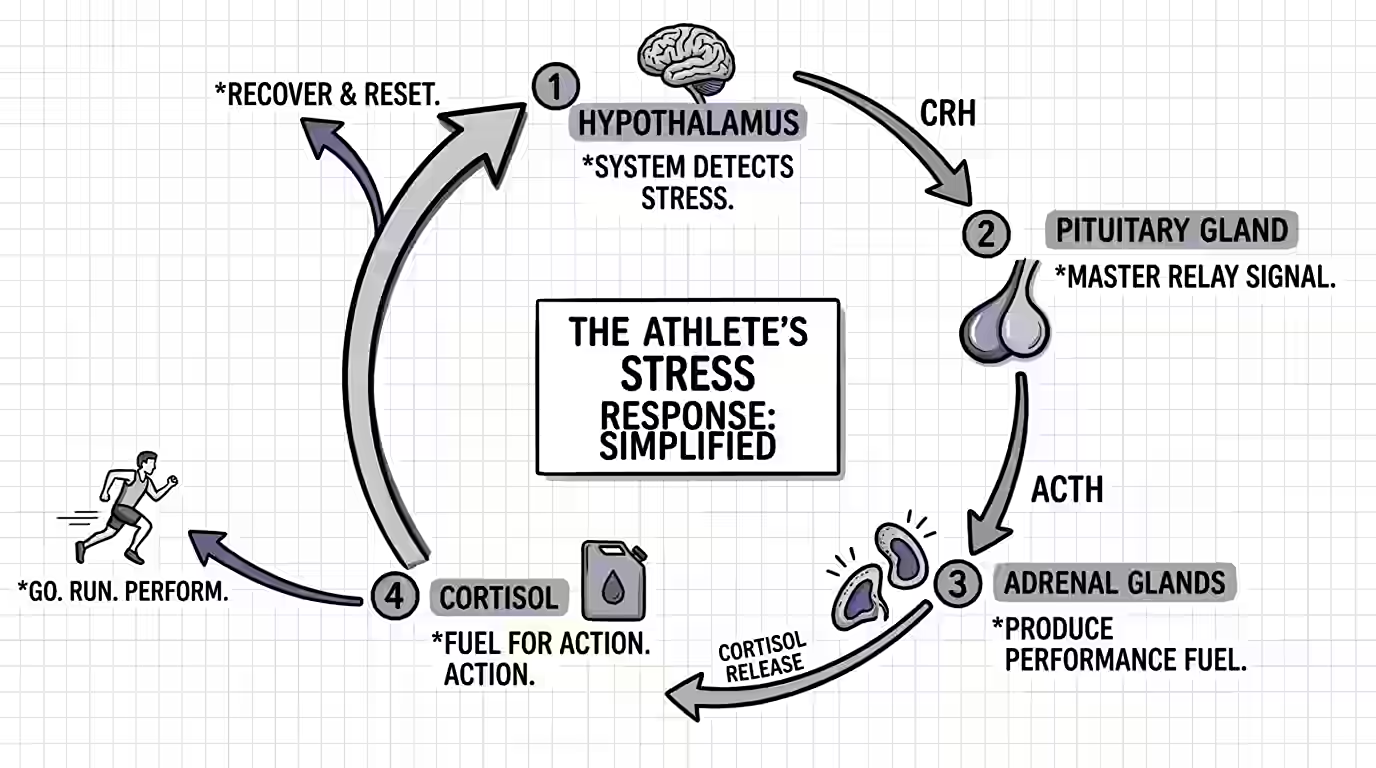
Cognitive Reframing of the Spike: The physiological sensations of "anxiety" and "excitement" are nearly identical—racing heart, butterflies, dilated pupils. The difference is the mental label. A hardened mind views the Stage 3 cortisol release as "fueling the engine" for Stage 4. Instead of interpreting the adrenaline spike as a threat, the athlete labels it as the body preparing for peak performance. This prevents the "memory spiral" and keeps the prefrontal cortex in control of the motor skills.
By understanding that stress is a biological resource, the athlete moves from a defensive posture to a proactive strike. This is the difference between an amateur who is "nervous" and a warrior who is "ready."
The Hypothalamic-Pituitary-Adrenal Axis: The Biological Engine of Performance
The infographic outlines a four-stage closed loop that triggers the moment the gym noise reaches a high-leverage pitch:
- The Hypothalamus (The Detection Center): The brain detects a stressor—a looming shot clock, a hostile crowd, a superior opponent. It releases CRH (Corticotropin-releasing hormone), the first domino in the performance chain.
- The Pituitary Gland (The Master Relay): This gland receives the CRH signal and translates it into ACTH (Adrenocorticotropic hormone). It is the master relay that tells the body the stakes have changed.
- The Adrenal Glands (The Fuel Factory): Located atop the kidneys, these glands receive the ACTH signal and produce "performance fuel" in the form of cortisol.
- Cortisol (Fuel for Action): This hormone is the grease on the gears. When released, it provides the metabolic energy for the "Go. Run. Perform." phase. The cycle then feeds back to the hypothalamus for a "Recover & Reset."
Why Process Goals Beat Outcome Goals (The SMART Audit)
Most teenagers focus on the scoreboard. They want the scholarship or the social media validation of a win. This outcome-based thinking is a trap. Outcomes are influenced by external factors a player cannot control. To fix this, parents must use the SMART criteria with a cynical edge.
A goal is a contract. Audit your teen's objectives using this framework to cut through the excuses:
- Specific: Stop saying "I want to get better." Say "I want to increase my free-throw percentage by five points."
- Measurable: You need a number. If you can't count it, you can't coach it.
- Achievable: The goal must be a "stretch," but not a delusion.
- Relevant: Does this move the needle in the game? Focus on the grease on the gears.
- Time-Bound: Every goal needs a deadline. Without a "by when," the work never starts.
This builds self-efficacy because these goals are entirely within the player's control. It is a clinical shift from achievement goal theory to mastery-oriented behavior. Focus on the work, not the trophy.
7 Daily Mental Toughness Drills for Teens
Mental fortitude is built through habit stacking. It is a daily mental workout. These reps build the mental models required to survive the apathy epidemic.
- The "Next Play" Reset: Spend two minutes visualizing a major mistake. Practice the "Flush It" reset until it feels mechanical.
- Pre-performance Routine: Develop a specific physical trigger. Tie your laces a certain way. Touch the jersey. Signal the transition to optimal alertness.
- Positive Self-Talk Audit: Record the internal dialogue during a difficult drill. Replace every "I can't" with a concrete "How do I" question.
- Intentional Discomfort: Use the "one more rep" rule. When the body says it is finished, execute one perfect rep.
- Attentional Fast: Turn off all screens for ninety minutes before a game. Protect the prefrontal cortex from directed attention fatigue.
- The Championship Visualization Script: Follow the sensory protocol below once per day.
- Stress Management Log: Write down one thing that caused anxiety during the game and one way you controlled your reaction to it.
The Championship Visualization Script (PETTLEP Protocol)
- The Senses: Close your eyes. Smell the floor wax of the gym. Hear the squeak of sneakers. Feel the dry, textured leather of the ball against your skin.
- The Pressure: See the clock. There are ten seconds left. You are down by one. Feel the cool air in the gym. Notice the sweat on your forehead.
- The Execution: See yourself receive the ball. Feel its specific weight. Feel the smooth motion of your jump shot. See the ball rotate through the air. Hear the snap of the net.
- The Emotion: Feel the relief and the confidence. Do not celebrate; simply acknowledge the execution. You have been here before.
How to Coach Mental Toughness Without Burnout
Parents often contribute to the apathy epidemic by providing a soft landing for every failure. This is an appalling miscalculation. It creates a fixed mindset where the teen believes their talent is a static commodity. Carol Dweck's research proves that feedback must be anchored in effort, not result.
If you tell a kid they are a "natural," you are telling them they don't need grit. The moment they hit a wall, they will quit. Their identity is tied to being "talented." True coaching requires positive reinforcement of the struggle itself. Praise the sweat, not the score.
Burnout occurs when the pressure of outcome-based expectations outweighs the joy of mastery. To avoid this, focus on the athlete's autonomy. They must own the goal. If the parent wants the win more than the athlete, the infrastructure of mental toughness will eventually collapse under the weight of resentment.
One of the more modern coaching techniques out there is the odd-sided drill; this is a drill or scrimmage where one player position is removed from one of the teams. So, in hockey it might be 5 offensive players on 4 defensive players and maybe the same setup in a similar basketball drill. This puts a tremendous amount of pressure on the short-sided defensive squad, forcing them to work harder. Forcing them to a disadvantage that more frequently induces failure. This is a physical and mental challenge that is otherwise difficult to simulate consistently. This is controlled pressure. Players get used to being in high-pressure, disadvantaged scenarios and hopefully, build some mental toughness as a result. Basketball Canada heavily endorses these kinds of drills; us coaches were taught to use them in our training sessions with the coaches from Team Canada. We were told that Canada's then remodeled training system was being exported to many international teams because it exploited the most modern ideas out there.
Equipping the Young Athlete: The "Trojan Horse"
Most sports psychology books are written for people in lab coats. They are light on the visceral reality of the bench. A young athlete needs something that speaks their language without the corporate fluff.
500 Motivational Quotes for Teen Boys is the ultimate Trojan Horse for mental toughness. It distills elite performance psychology into high-impact "mental reps" that build a short memory for mistakes and an unbreakable internal locus of control. It's the daily mindset conditioning a young athlete needs to win the inner game before they ever step onto the court.
The book focuses on accountability and self-discipline. It rejects the sentimentality of modern "participation trophy" culture. It is a tactile resource for a generation drowning in digital noise. It is the gift of a hardened mind.
Mental fortitude is the only thing that separates a talented teen from a permanent victim of the apathy epidemic. It is the shield that allows them to stay in the arena when the world is trying to flatten them. Stop buying them gadgets that soothe their boredom. Give them the drills that build their grit.