Resilience for Teens: The Warrior Mindset Without the Lectures
By Brazenly False (Coach Shane Lypka)
Resilience for teens is the ability to bounce back from adversity, trauma, or a sudden, acute failure. It is the psychological shock absorber. A teen with a Warrior Mindset doesn't view a setback as a permanent defeat or an excuse to tap out; he views it as a necessary rep in the gym of life, building the mental muscle required to survive the long game.
Resilience is highly reactive. It is tested in moments of acute stress.
Teach your child that resilience is built action by action. Let them see that they have the ability to cope and the power to build resilience on their own terms.
Sometimes it is as easy as planting a seed with young people. Try offering your teen one of the many mental toughness quotes we've curated.
Try the Resilience Pulse-Check to set a baseline:
🛡️ Resilience Pulse-Check
Answer all 5 questions to instantly see where your son stands on the resilience spectrum.
The New Language of Resilience
When we talk about resilience, we often mistake it for a lack of emotion. I see parents on the sidelines shouting "tough it out!" as if resilience is a synonym for "suppress everything until you explode." It isn't. Resilience is the ability to navigate the emotional ups and downs of life without losing your center.
In my years coaching, I've realized that resilient teens aren't the ones who never fail; they're the ones who have a mindset that views failure as "data." In the study of resilience, we find that resilience isn't an innate trait you're born with—it's a muscle. And like any muscle, it requires resistance to grow. If we bubble-wrap our sons, we deny them the very adversity they need to develop the grit required for adulthood.
"The impediment to action advances action. What stands in the way becomes the way."
That "roadblock" isn't stopping you; it's training you. Every time you fail, you're just finding a new way to get stronger. The obstacle is the workout. I love to quote history's great thinkers; they're gifting us knowledge built over a lifetime of efforts, failures, and successes. Many parents ignore it because "they know better." I'm here to let you know that, we don't. If your gut says right now "don't tell me how to raise my son," then please stop reading. You are wasting your time.
Research into resilience in adolescents shows that they are intensely focused on autonomy. When you offer a solution, they see a threat to their independence. This is why the approach of "bite-sized wisdom" is so effective. Instead of a workbook or a therapy-heavy tome, they need a warrior code they can digest on their own terms. I've found that a single, hard-hitting quote from a thinker like Marcus Aurelius or a modern titan of industry can do more for a teen's mental resilience than a week of "we need to talk" sessions. They'll be more likely to listen to a dead philosopher than a live parent.
Resilience starts with the words we feed our minds. We've curated mental toughness quotes for teen boys to build the internal dialogue required to weather any storm.
Build Resilience: Why Stoicism is the Ultimate Parenting Hack
There is a thematic synergy between the challenges of modern adolescence and the ancient philosophy of Stoicism. Stoicism teaches that while we cannot control external life events, we have absolute authority over our internal response. This is the cornerstone of mental resilience. For our children and adolescents, this shift in perspective is the difference between drowning and swimming.
For a teen boy dealing with high anxiety or a social stressor, understanding that they are the masters of their own minds is a superpower. We need to teach resilience by showing them that they aren't victims of their circumstances. Resilient children learn early on that their power comes from within. Resilience is built when we stop solving their problems and start asking them how they plan to solve them.
When coaching a kid who is frustrated by a particular defender on the basketball court, I ask him what he could do to solve the pesky player. I might ask him what keeps happening. He might say "every time I shoot a jump shot, he blocks it." I then ask "what could you do instead?" The player thinks and comes back with "I'll fake the shot and drive to the basket for a layup!" And that's how you do it. In the moment, they're nothing but frustrated, but with a little coaxing (or coaching), the player figures it out and now has a tool to avoid his problem and the frustration that comes with it. And it was all his idea.
To cultivate a "Warrior Mindset" in a modern teenager is not about preparing them for physical combat; it is about fortifying their minds against a culture that constantly invites them to take the path of least resistance. The warrior we need today is the boy who can sit in the uncomfortable friction of a challenge without reaching for a screen to numb the frustration. This requires a profound shift in how they process adversity. Dr. Angela Duckworth, in her foundational psychological research on achievement, notes that "grit grows as we figure out our life philosophy, learn to dust ourselves off after rejection and disappointment, and learn to tell the difference between low-level goals that should be abandoned quickly and higher-level goals that demand our tenacity."
But this mindset cannot be inherited, and it certainly cannot be lectured into existence. It must be forged through their own personal agency. When we constantly intervene to smooth out our sons' paths, we accidentally rob them of the very resistance they need to grow strong. Dr. Kenneth Ginsburg, a leading pediatrician and researcher specializing in adolescent resilience, encapsulates this harsh reality perfectly: "We cannot protect our children from life's storms, but we can equip them with the skills to weather them... they need to be guided, to be trusted, and to be allowed to learn from their own mistakes."
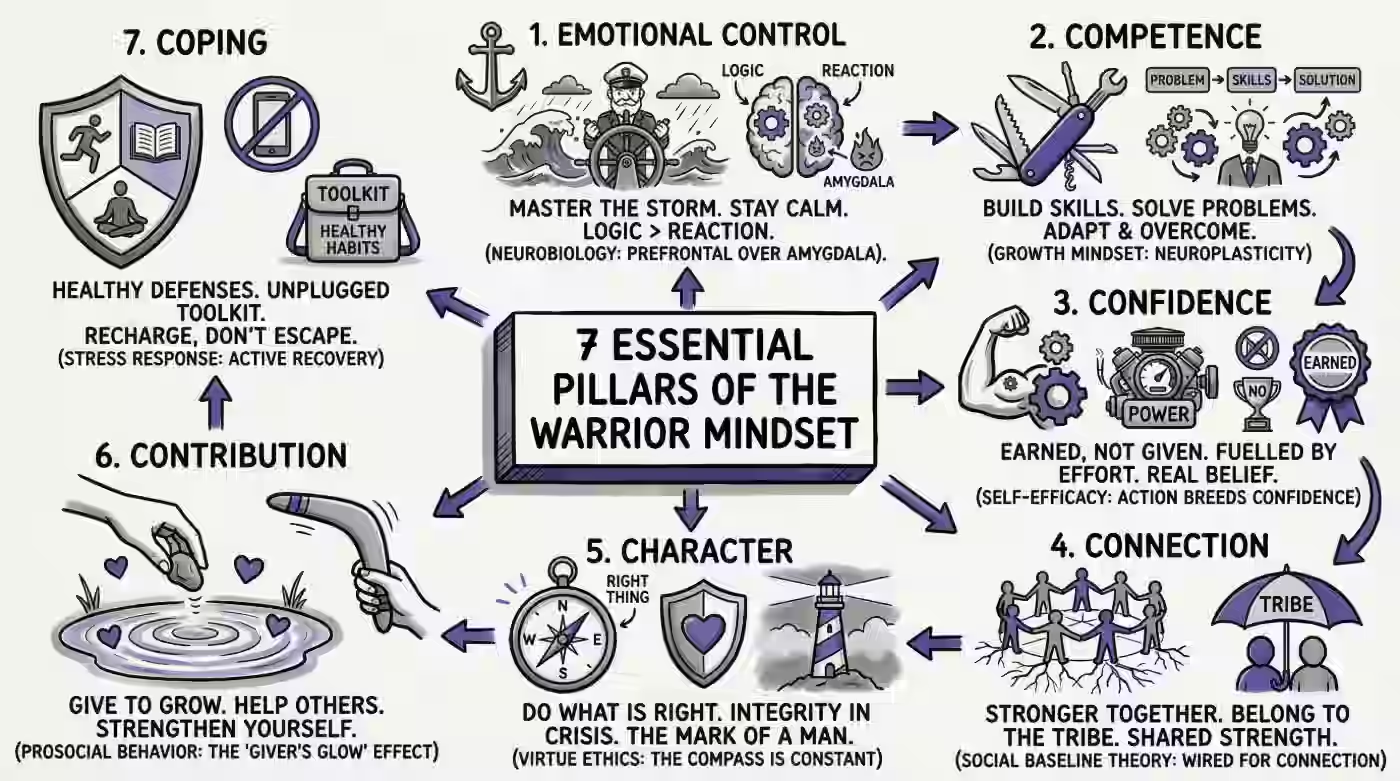
Equipping them with a "Warrior Mindset" means stepping back from the role of the rescuer and stepping into the role of the coach. We must hand them the blueprint for their own internal fortress and trust them to do the heavy lifting. That construction relies on seven foundational pillars:
7 Essential Pillars of the "Warrior Mindset"
To help build this internal strength, we look at the 7 essential components that correlates of resilience often highlight. These are the building blocks of emotional resilience:
- Emotional Control: Managing the emotional resilience needed to stay calm when things go sideways, including the arousal-regulation skills used in mental toughness training for athletes. Read the documented court, sleep, and fatigue data in the Teen Athlete Burnout Case Study: 14-Day Recovery Plan.
- Competence: Developing actual problem-solving skills so they feel capable in the face of adversity.
- Confidence: Not the "participation trophy" kind, but a deep-seated self-confidence earned through effort.
- Connection: A sense of belonging to something bigger than themselves—a team, a family, a community.
- Character: Understanding that doing the right thing during tough times is the mark of a man.
- Contribution: Realizing that when they help others, they strengthen their own wellbeing.
- Coping: Having a toolkit of healthy coping mechanisms that don't involve a screen.
Mental: Training the Brain for the Long Game
Resilience is built in the small, quiet moments. It's built when a boy chooses to talk to someone about his frustrations rather than smashing a controller. It's built when he learns to keep things in perspective after a bad grade or a breakup. This is how children develop resilience naturally over time.
As a coach, I tell my players that resilience doesn't mean you don't feel the sting of a loss. It means you don't let a single negative life event define your entire season. We must help our children realize that part of development involves making mistakes. We need to frame these as opportunities for growth rather than mental health problems.
Many parents today are dealing with a specific kind of stressor: the apathetic teen. This apathy is often a shield—a way to avoid the pain of trying and failing. If the shutdown runs deep, start by understanding the difference between teen apathy and depression before choosing an intervention. To break through, we have to encourage self-advocacy. Teens learn best when they feel they are the owners of their destiny. Teens need to feel that their efforts matter, and raising resilient boys means moving them from "I don't care" to "I can handle this."
Resilient teens understand that adversity is a part of the human experience. Whether it is adverse childhood experiences or simple times of stress, the ability to cope is what separates those who thrive from those who merely survive. Resilience is crucial because it prepares them for a world that is chaotic, divisive, and ever-changing.
Strategies and Activities to Help Build RESILIENCE (The Shock Absorber)
Goal: To teach your teen how to process failure, regulate their emotions, and quickly recover their baseline confidence.
If you want to help your teen build a more resilient mindset, you have to meet them in their moments of acute distress. Resilience is not built by preventing them from falling; it is built by coaching them on how to stand back up. The goal is to detach their self-worth from temporary setbacks.
- The "24-Hour" Emotional Window
When a teen experiences a sharp failure (failing a driving test, getting cut from a team, a painful breakup), the instinct is often to immediately say, "It's okay, you'll get it next time!" This invalidates their pain. Instead, establish the 24-hour rule. Give them 24 hours to be completely frustrated, sad, or angry. Let them feel the sting. But once the clock expires, the rule is that the wallowing ends and the strategy phase begins. This teaches emotional regulation: feel the feeling, but don't move into it. - The "Autopsy Without Blame"
When they bomb a test, sit down and conduct an objective autopsy of the failure. Remove emotional language. Ask: "What specifically went wrong here? Did you study the wrong chapters? Did you run out of time? Did you panic?" This frames failure as a data point, not an identity. It teaches them that a bad grade means "my study system failed," not "I am stupid." - Out-Loud Parental Failure (Role Modeling 2.0)
Kids don't learn resilience from watching their parents succeed; they learn it from watching them fail. Don't just quietly fix your own mistakes. Narrate them out loud. Say at the dinner table: "I completely botched a presentation at work today. I felt humiliated. But here is how I'm going to fix it tomorrow." Let them see the mechanics of your recovery. - Demystifying the Catastrophe
Teens often lack resilience because they catastrophize. A bad grade feels like their life is over. Play the "And then what?" game. "Okay, you failed the math mid-term. And then what?" -> "I'll get a bad final grade." -> "And then what?" -> "I won't get into my top college." -> "And then what?" Help them map out the absolute worst-case scenario to show them that, even in the worst case, they will survive and have options.
We often assume kids know how to deal with stress, but coping strategies must be taught. From box breathing to self-care activities, these are skills to help them manage mental health issues before they become overwhelming. When we build emotional resilience, we give them the armor they need for the real world.
The goal of raising resilient teens isn't to create a person who never feels pain. It's to create resilient people who know that pain is a signal, not a destination. Resilience will help our sons back from adversity with more wisdom than they had before. Levels of resilience vary, but everyone can improve with the right mindset and social support.
In my experience, the most resilient boys aren't the loudest ones; they are the ones who have cultivated an inner silence. They have a warrior's mental resilience, fueled by the words of those who came before them. By exploiting the knowledge of history's greatest thinkers—the very people who have already answered the "if only I had known then" conundrum—our sons can develop resilience and mental toughness, getting ahead of where they would have been on their own.
I am not a medical professional, and this is not health research or medical advice. It is the hard-won experience of a parent and a coach who has seen adolescence from the front lines. Set an honest baseline with the Teen Resilience Pulse-Check, then reinforce the lessons with our books on mental toughness. Because in the end, resilience isn't something you give them; it's something you help teens find within themselves.