What Is a Hardy Personality? The 3 Core Traits (Explained)
By Brazenly False (Coach Shane Lypka)
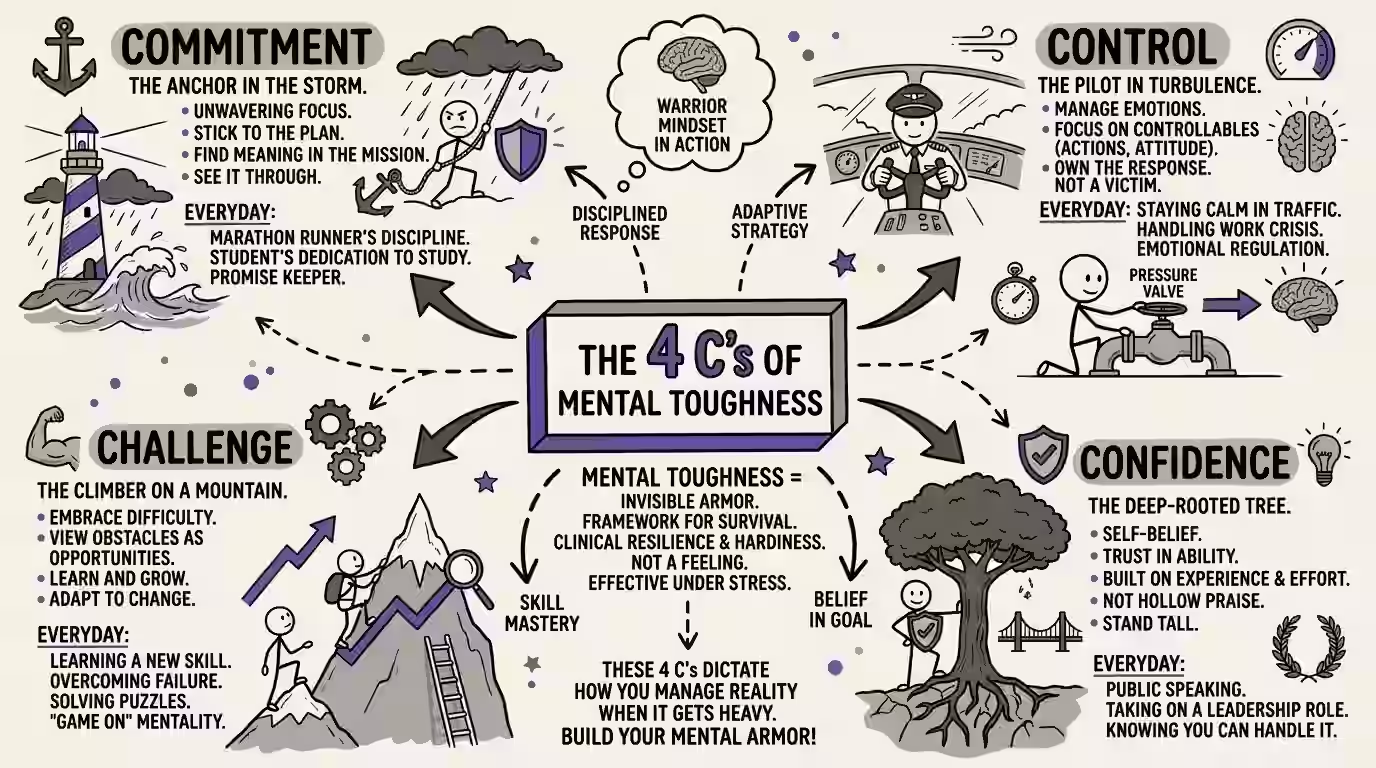
Mental toughness is not a feeling. It is an active framework for staying effective when reality gets heavy. Hardiness is the original, research-backed blueprint for that framework, and it is the foundation every serious resilience model is built on.
Definition
A hardy personality is a psychological framework defined by Dr. Suzanne Kobasa that describes individuals who remain resilient and thrive under extreme stress. It is characterized by three core dimensions known as the 3 C’s: Commitment (staying deeply engaged with life and goals), Control (believing you have personal influence over outcomes), and Challenge (viewing change and hardship as opportunities for growth rather than threats).
These traits become visible under competitive pressure. See how coaches translate them into mental toughness for young athletes through repeatable drills and in-game resets.
The Research: Kobasa, Maddi, and Illinois Bell Telephone
In 1979, psychologist Dr. Suzanne Kobasa, working with Dr. Salvatore Maddi at the University of Chicago, studied managers at Illinois Bell Telephone. The company was going through a massive federal deregulation and restructuring. Thousands of jobs were cut, roles changed overnight, and nobody knew what came next.
Roughly two-thirds of the managers broke down. They suffered heart attacks, depression, anxiety, and burnout. The other third faced the exact same stress and thrived. Kobasa and Maddi asked a simple question: what made the difference? The answer was not income, intelligence, or luck. It was a specific set of attitudes. They called it hardiness.
The 3 C's of a Hardy Personality
To understand how a person stays locked onto a goal under pressure, you have to break down the 3 C's.
1. Control (Internal Locus of Control)
Control is the belief that your actions shape your outcomes. Psychologists call this an internal locus of control. When a teen faces a bad call, an unfair teacher, or a tough loss, he does not waste energy blaming outside forces. He focuses strictly on the variables he can move: effort, attitude, and preparation. Low-control people feel like life happens to them. Hardy people act on life.
2. Commitment (Active Involvement vs. Alienation)
Commitment is the refusal to retreat into apathy. Fragile individuals pull away when pressure spikes. They check out, go numb, and disconnect from school, team, and family. Kobasa called this alienation. Hardy individuals do the opposite. They lean in and stay involved, because they believe what they are doing has meaning.
Use stoic mental toughness quotes as short commitment cues when a long lecture would be ignored.
3. Challenge (Growth vs. Threat)
Weak minds expect life to be easy and panic when it isn't. The hardy personality expects friction. When change or difficulty shows up, he does not read it as a threat to his security. He reads it as the exact rep he needs to get better. Challenge is the trait that turns a high-pressure moment into a training ground.
High Hardiness vs. Low Hardiness
| Trait | High Hardiness | Low Hardiness |
|---|---|---|
| Control | "What can I do about this?" | "There's nothing I can do." |
| Commitment | Stays engaged with school, team, and family | Withdraws, checks out, goes numb |
| Challenge | Sees change as a chance to grow | Sees change as a threat |
| After a Loss | Reviews film, adjusts, returns | Blames refs, quits, or spirals |
| Under Stress | Problem-solves and takes action | Avoids, distracts, or shuts down |
| Health Impact | Lower rates of stress-related illness | Higher burnout and illness risk |
See how these three traits were applied in a documented coaching case to help an athlete respond to rejection in our 6-week athletic cut hardiness case study.
From Hardiness to Mental Toughness: The 4th C
Hardiness is the foundation. Decades later, Professor Peter Clough and Doug Strycharczyk expanded Kobasa's 3 C's into the MTQ48 mental toughness model. They kept Control, Commitment, and Challenge, and added a fourth: Confidence, which covers belief in your own abilities and confidence in dealing with other people.
In short: hardiness explains how a person resists stress. The four MTQ48 Pillars explain how a person performs under it. If your son has the 3 C's, he has the base. Confidence is what lets him use it when the whole gym is watching. Measure where he stands today with our free mental toughness check.
3 Coaching Drills to Build Hardiness in Teens and Athletes
Drill 1: The Control Sort (Builds Control)
After a bad game or bad grade, have him split a sheet of paper into two columns: "I Control" and "I Don't Control." Refs, weather, and the teacher's mood go on the right. Sleep, effort, film study, and study time go on the left. Then he picks one item from the left column to act on within 24 hours. Blame gets replaced by a plan.
Drill 2: The Daily Non-Negotiable (Builds Commitment)
He chooses one small action he will do every day for 30 days, no matter what: 50 free throws, 20 minutes of reading, or one hard conversation. The size doesn't matter. Showing up does. Commitment is built by keeping promises to yourself when nobody is checking.
Drill 3: The Threat-to-Rep Reframe (Builds Challenge)
When he says "This is going to be awful," ask one question: "What skill does this force you to build?" A tough opponent becomes a speed rep. A hard exam becomes a focus rep. Practice the reframe out loud until it becomes automatic. Stress stops being a threat and starts being training.
Hardy Personality FAQ
What is the definition of a hardy personality?
A hardy personality is a psychological construct developed by Dr. Suzanne Kobasa in 1979 that describes an individual's ability to remain physically and mentally healthy under severe stress. It is characterized by three core attitudes known as the 3 C's: Control, Commitment, and Challenge.
What are the 3 C's of a hardy personality?
The 3 C's of a hardy personality are Control (believing you influence your own outcomes), Commitment (active engagement in goals and daily life rather than alienation), and Challenge (viewing unexpected change and difficulty as opportunities to grow rather than threats).
Can a hardy personality be learned or developed?
Yes. Psychological hardiness is not a fixed genetic trait. It can be developed through cognitive reframing drills, building an internal locus of control, practicing stress exposure, and shifting from outcome-based anxiety to process-based daily execution.
What is the difference between hardiness and mental toughness?
Hardiness is the foundational 3-part framework (Control, Commitment, Challenge) focused on stress immunity. Mental toughness is an expanded 4-part model (MTQ48) developed by Clough and Strycharczyk that adds a fourth C: Confidence (in personal abilities and interpersonal situations).
Ready to put these traits into practice? Explore our 30-day resilience challenges or dig into the 177 Mental Toughness Secrets of the World Class to see how elite performers live these three traits every day. For recovery after setbacks, use our practical guide to building resilience in teens.